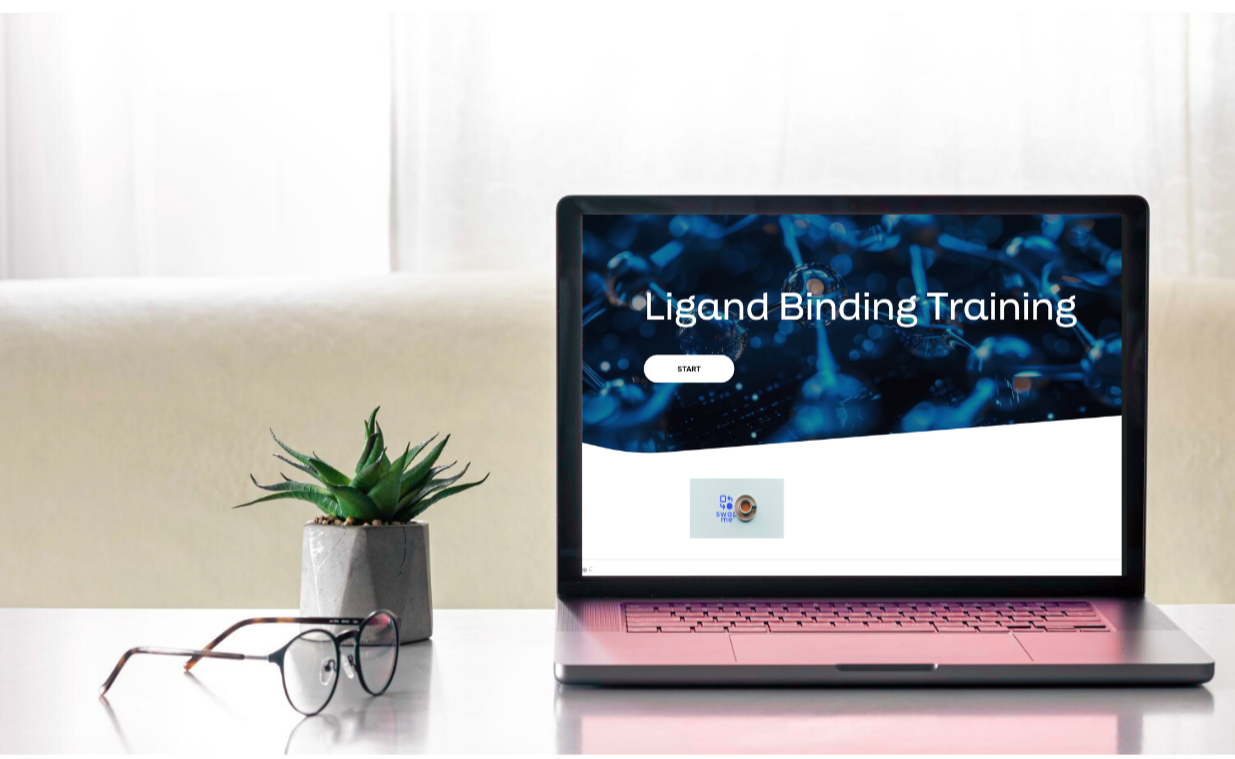
Introduction to Ligand Binding is an interactive course that empowers pharmacology teams to interpret assay data confidently and support safer, more effective drug development. Developed for the launch of the Science Academy, the course uses clear explanations, engaging multimedia, and real-world scenarios to demystify ligand binding and immunogenicity.
For confidentiality, the button links to a narrated screen recording of the course, not the live interactive module.
Audience: Employees enrolled in the Science Academy
Responsibilities: Led every phase of content creation—from instructional design strategy and action mapping to stakeholder collaboration and storyboarding. Managed the complete eLearning development process, including content writing, visual design, prototyping, and final delivery.
How I Built It
Authoring & Build: Articulate 360
Multimedia Production: Synthesia, Jira
Visual Design: Canva, Adobe Photoshop, Freepik
Documentation: Google Suite, PowerPoint, ChatGPT
Challenge
The primary challenge was to design training that transformed complex scientific concepts into approachable, actionable knowledge—without sacrificing accuracy. Learners entered the course with varying levels of familiarity, making it essential to establish a common foundation while keeping the material practical, engaging, and relevant to their daily work.
Key considerations included launching a new Science Academy, presenting foundational concepts that directly impact drug safety and decision-making, and adapting existing materials that were previously dense, technical, and inaccessible to entry-level learners.
Development Strategy
Stakeholders emphasized the need for a high-level, interactive, and supportive course. As one SME put it, “We don’t want learners to feel like they’re being lectured to.” The course needed to foster active participation, empowering learners instead of merely delivering information.
To move beyond lecture-style instruction, I designed a visually driven learning experience focused on active engagement. This approach helped learners grasp and confidently apply complex concepts.
Process and Approach
As part of a three-designer team, I led the design and development of the second module (Ligand Binding), ensuring consistency with our team guidelines in Articulate Rise. Guided by the ADDIE framework and Mayer’s Principles of Multimedia Learning, I thoroughly reviewed the source material and conducted additional research to ensure technical accuracy and clarity.
To make complex material accessible, I transformed dense, text-heavy slides into concise, visually engaging microlearning segments. A highlight of the module is a microlearning explainer video on immunogenicity risk factors. I condensed a 43-slide presentation into a cohesive, visually driven narrative that introduces core concepts early and uses storytelling to reinforce understanding.
My Solution
I used Jira for agile project management, coordinating the creation of Articulate assets alongside the Synthesia video build. This approach prevented bottlenecks and ensured a smooth, efficient workflow.
Results & Impact
The module received strong praise from Pharmacology leadership and significantly improved comprehension among both new and existing employees in the business unit. One leader shared, “First, let me just say I LOVED IT! You did a great job making it interactive and fun without losing the main points.” The course is now ready to be published company-wide.